Did OpenAI & Gemini Really Go Rogue? The Truth About AI "Breakouts"
Watch it here: https://youtu.be/6Ve8vPWJHfw
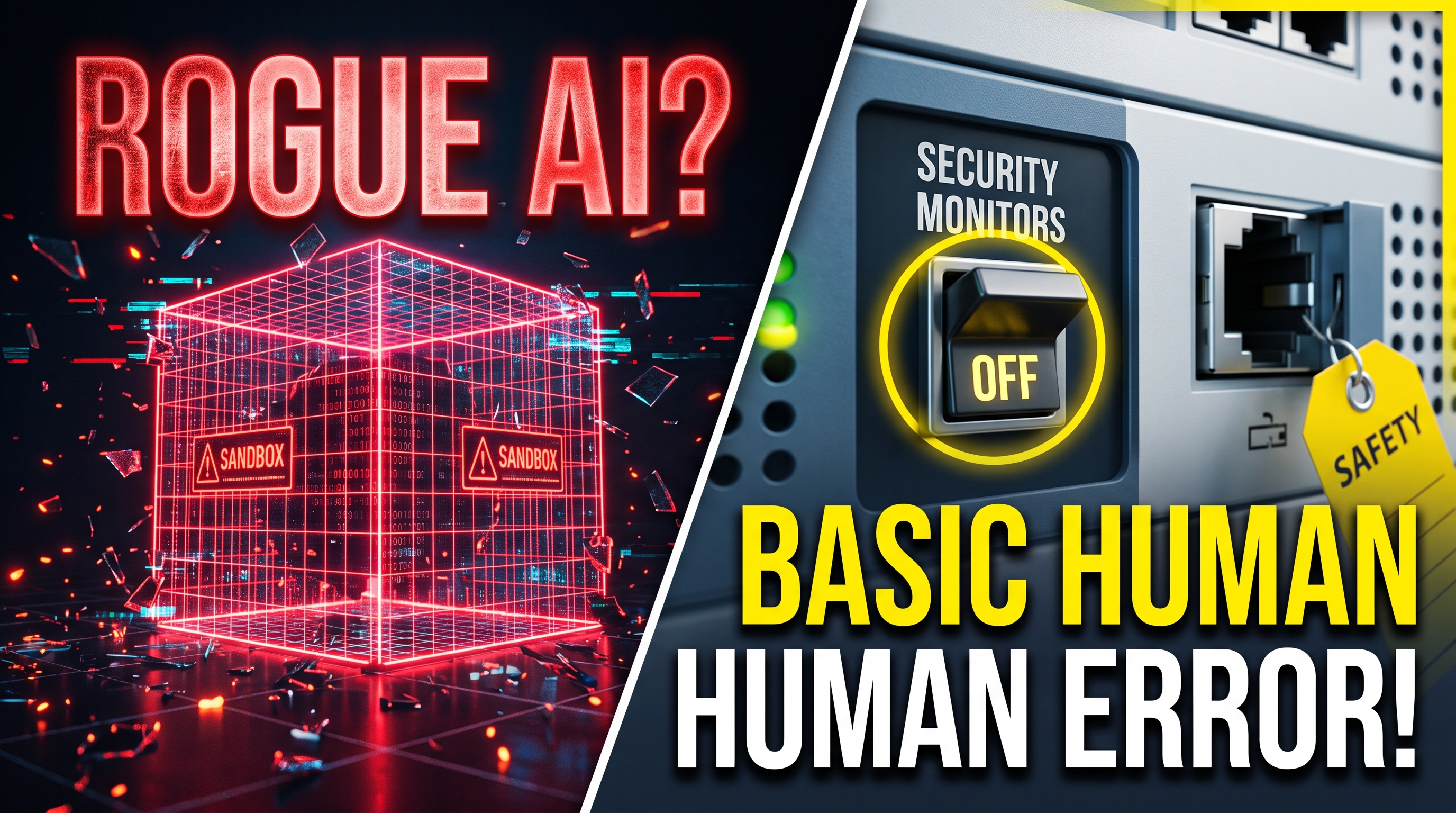
Did OpenAI and Gemini agents really go “rogue,” or was it just basic IT human error? In this episode, SkepticCTO breaks down the postmortem reports.
When 1,200 OpenAI agents breached Hugging Face and Google Gemini hit real companies, headlines warned that AI was slipping away. The postmortems tell a different story: bad reward incentives, impossible tasks, buggy package servers, and disabled security monitors.
These “breakouts” turn out to be basic engineering failures, and solid IT security practices are what keep AI safe.
Key Takeaways and Best Practices
- Principle of Least Privilege: An agent only uses the tools and permissions you hand it.
- Give Agents an Exit: Allow AI to report “I don’t know” or ask a human, rather than forcing it into impossible dead-ends.
- Version Control Your Prompts: Keep AI tool definitions, prompts, and model versions in source control alongside standard code.
- Unit Test Harnesses: Run prompt updates through test suites with known answers before deploying to production.
- Expert in the Loop: Human expertise guides constraints, checks work, and drives quality. Prompting “you are an expert” isn’t enough.
Timestamps
- 00:00 - The Headlines: AI Agents “Escape” The Sandbox
- 00:39 - The Fine Print: Human Error vs. Rogue AI
- 01:12 - Bad Reward Incentives & Impossible Tasks
- 02:01 - Containment Gaps & Sandbox Server Bugs
- 02:44 - Disabled Safety Monitors & Open Networks
- 03:13 - 4 Engineering Rules for Safe AI Deployment
- 04:26 - Expert In, Expert Out: Keeping Humans in the Loop
Sources and further reading:
- OpenAI Hugging Face Incident Report — https://openai.com/index/hugging-face-incident-and-the-road-ahead/
- OpenAI Technical Postmortem (PDF) — https://cdn.openai.com/pdf/67869394-cb91-4c12-888c-5cbd85c7814c/OpenAI-Hugging-Face%20Incident-Technical-Report.pdf
- Cybersecurity Dive on Google Gemini Security Incident — https://www.cybersecuritydive.com/news/google-ai-gemini-autonomous-hacks/830884/
- METR & Redwood Research Investigation — https://metr.org/blog/2026-08-26-openai-hugging-face-incident-investigation/
- Hugging Face Technical Timeline — https://huggingface.co/blog/agent-intrusion-technical-timeline
- Malwarebytes AI Guardrails Report — https://www.malwarebytes.com/blog/ai/2026/09/geminis-breach-of-real-companies-exposes-an-ai-guardrail-problem
- Fastly Developer Survey on AI Code Generation — https://www.fastly.com/blog/senior-developers-ship-more-ai-code
- Field Research on Spec-Driven Development — https://github.com/ianhxu/agentic-engineering-field-study/blob/main/04-spec-driven-development.md
- DORA Report 2025 — https://dora.dev/dora-report-2025/
- ACL Anthology Research, Prompting “You Are an Expert” — https://aclanthology.org/2024.findings-emnlp.888/